
Juvenile Drug Court Celebrates 25 Years of Guiding Hawaiʻi Youth
Posted on Sep 17, 2026 in Featured News, News & Reports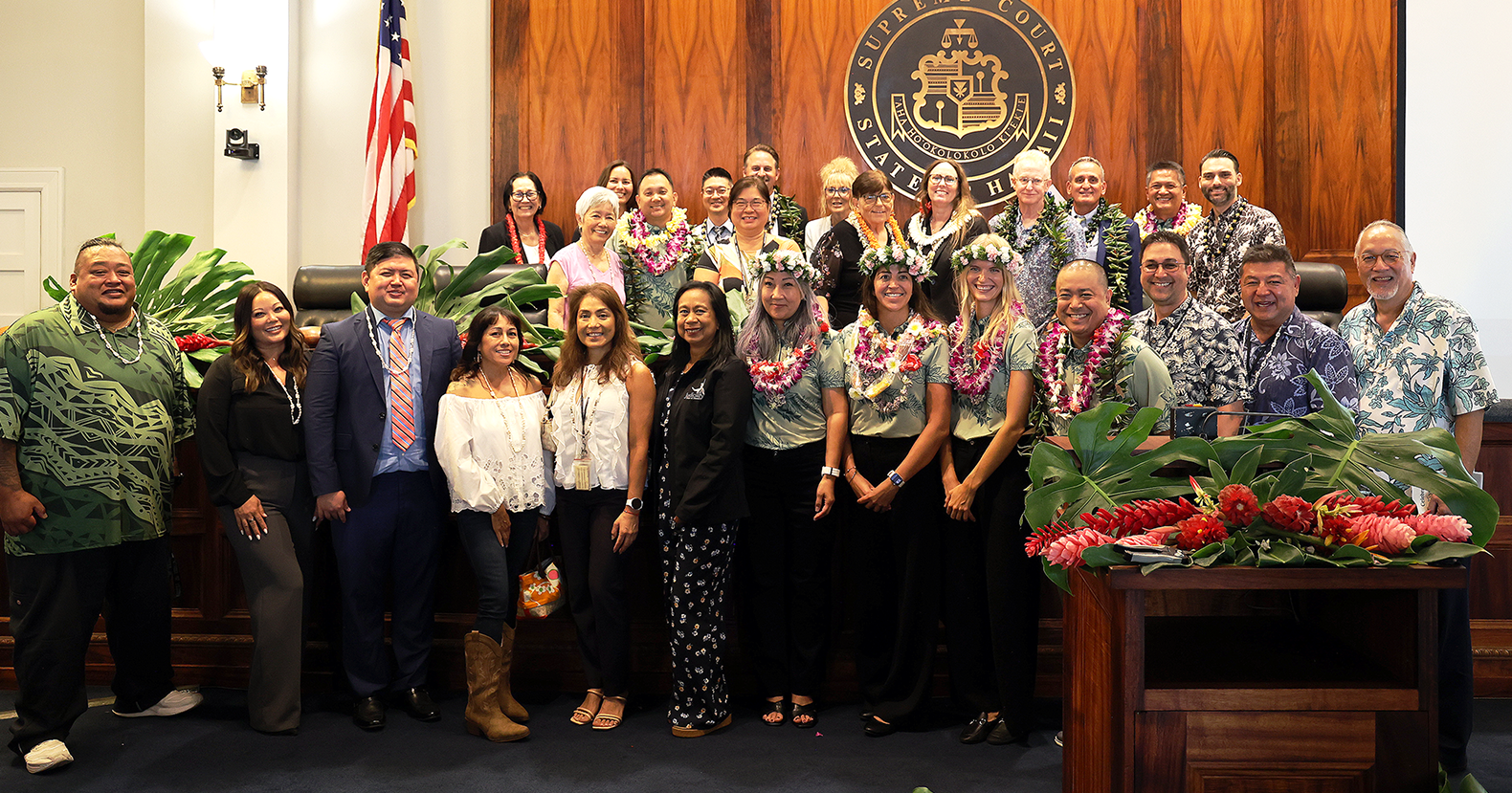
Current and former JDC judges, probation officers and team members pose in the Hawaiʻi Supreme Court courtroom at Aliʻiōlani Hale following the 25th anniversary celebration of the Juvenile Drug Court.
More than 100 people gathered in the Hawaiʻi Supreme Court courtroom on September 16 to celebrate the 25th anniversary of Juvenile Drug Court (JDC), a First Circuit Family Court program that has helped justice-involved youth struggling with substance use build healthier lives and avoid deeper involvement in the juvenile and criminal justice systems.
The September 16 celebration brought together current and former JDC judges, probation officers and other team members, program graduates and participants, service providers, and community partners who have contributed to the program during its 25-year history.
District Family Court Judge Robert J. Brown, the program’s current judge, said JDC is “a place where I feel we are doing genuine good, not only for the kid but for the community at large.”
Since its inception in 2001, 165 youth have successfully graduated from Juvenile Drug Court.
JDC was established at a time when the courts were seeing increasing substance use among youth and recognized the need for a different approach.
“There was increased use of methamphetamines and other heavier drugs by more kids, and it became clear that we really needed to find a new way to work with kids who are using drugs,” said retired Judge Karen M. Radius, JDC’s first judge.
Over the past 25 years, the program has combined intensive judicial supervision, substance use treatment, frequent contact with probation officers, drug testing, family therapy, support groups, and other services designed to help youth address substance use while holding them accountable.
Retired Judge Matthew J. Viola, one of five judges who have presided over JDC, called it “one of the most innovative programs that the Judiciary has had.”
He also emphasized the resilience of the youth who voluntarily participate in the program.
“There may be some misconceptions about our kids,” Viola said. “They may have gotten down by life and some of the decisions they made, but they always got back up.”
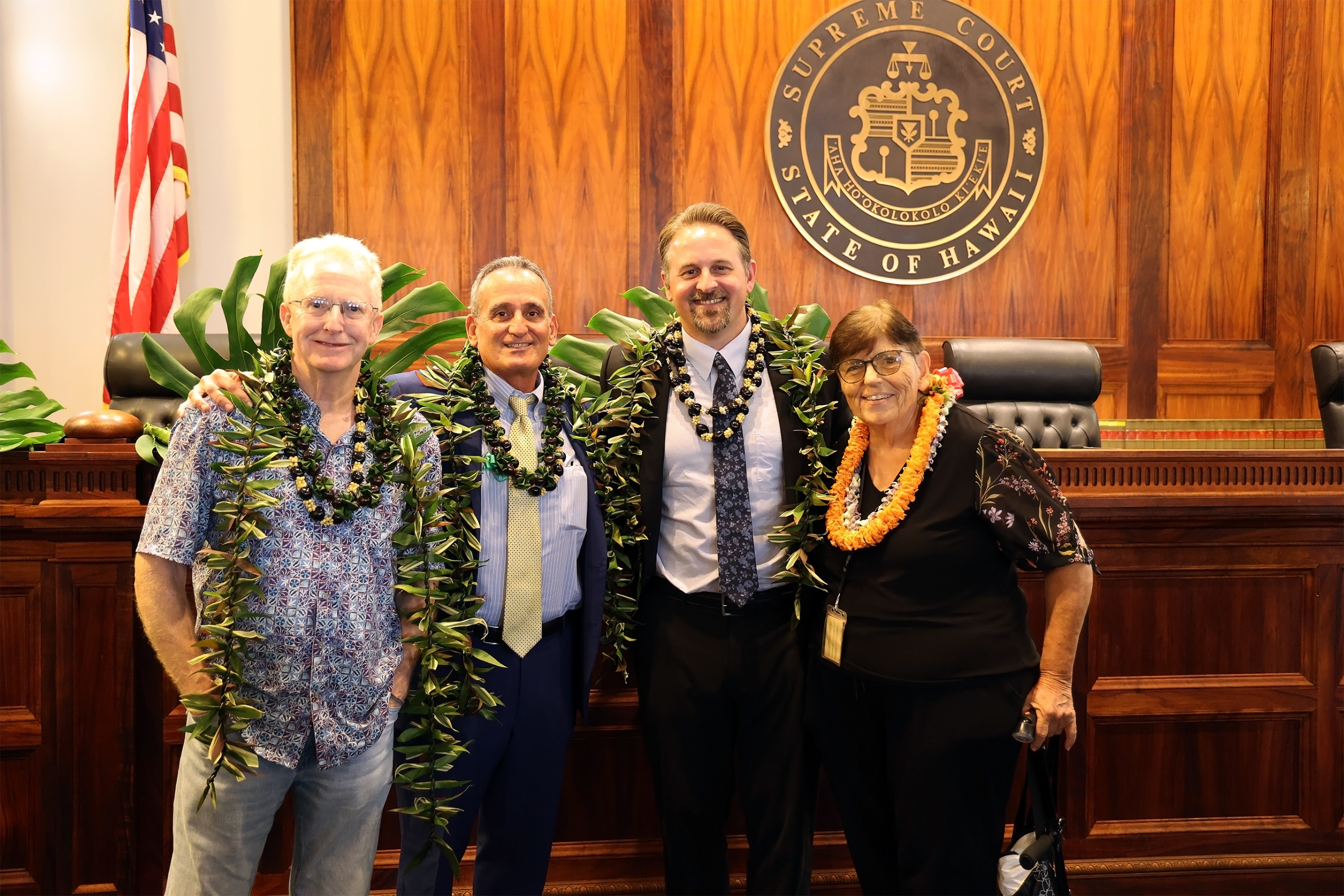
From left: Former Juvenile Drug Court Judges Mark Browning and Matthew Viola, current Presiding Judge Robert J. Brown, and Judge Karen M. Radius (ret.). Missing: Judge Brian Costa
A Team Supporting Youth and Families
JDC Administrator Joel Tamayo said the program depends on close collaboration among those working with participants and their families.
“It is a really big team effort,” Tamayo said. “JDC involves very intense probation, very intense treatment, and a real team approach.”
The judges credited JDC’s success to a collaborative effort involving probation officers, court clerks, bailiffs, deputy sheriffs, prosecutors, public defenders, treatment providers, and other community partners working toward a common goal.
“Everybody gets together with the singular goal of figuring out how we are going to support these kids,” Brown said. “How we are going to do right by them.”
Probation officers play an especially important role, maintaining frequent contact with participants and their families and helping youth navigate the requirements and challenges of the program.
“They’re doing the day-to-day work, maintaining the day-to-day contact with the youth, to hold them accountable,” Brown said.
Retired Judge R. Mark Browning recalled referring to the JDC probation officers as the “Delta Force of Probation Officers.”
“I remember the victories, and the victories only happened because we had a team of heroes,” Browning said.
Juvenile Drug Court Supervisor Derek Sumida said the program balances accountability with support.
“This program is not just all punitive,” Sumida said. “We’re here as a support for the youth, as well as their families.”
Probation Officer Sabrina Rodriguez reflected on reaching the milestone.
“Twenty-five years. That is incredible,” Rodriguez said. “I am so proud to be part of this event and to be on this team at this time.”
The impact of that support was also evident in comments from JDC graduates featured in a video shown during the celebration.
“My probation officer, he really sort of held my hand throughout the program, and most importantly, he always believed in me,” one graduate said. “So that helps me believe in myself.”
Another graduate said simply, “If it wasn’t for JDC, I probably wouldn’t have been this successful.”
Judge Brian A. Costa, who previously presided over JDC, similarly reflected on the difference the program can make in the lives of youth.
“Without Juvenile Drug Court a lot of these youth would be lost,” Costa said. “What I carry with me are the successes. There were times at Juvenile Drug Court that I got to see miracles.”
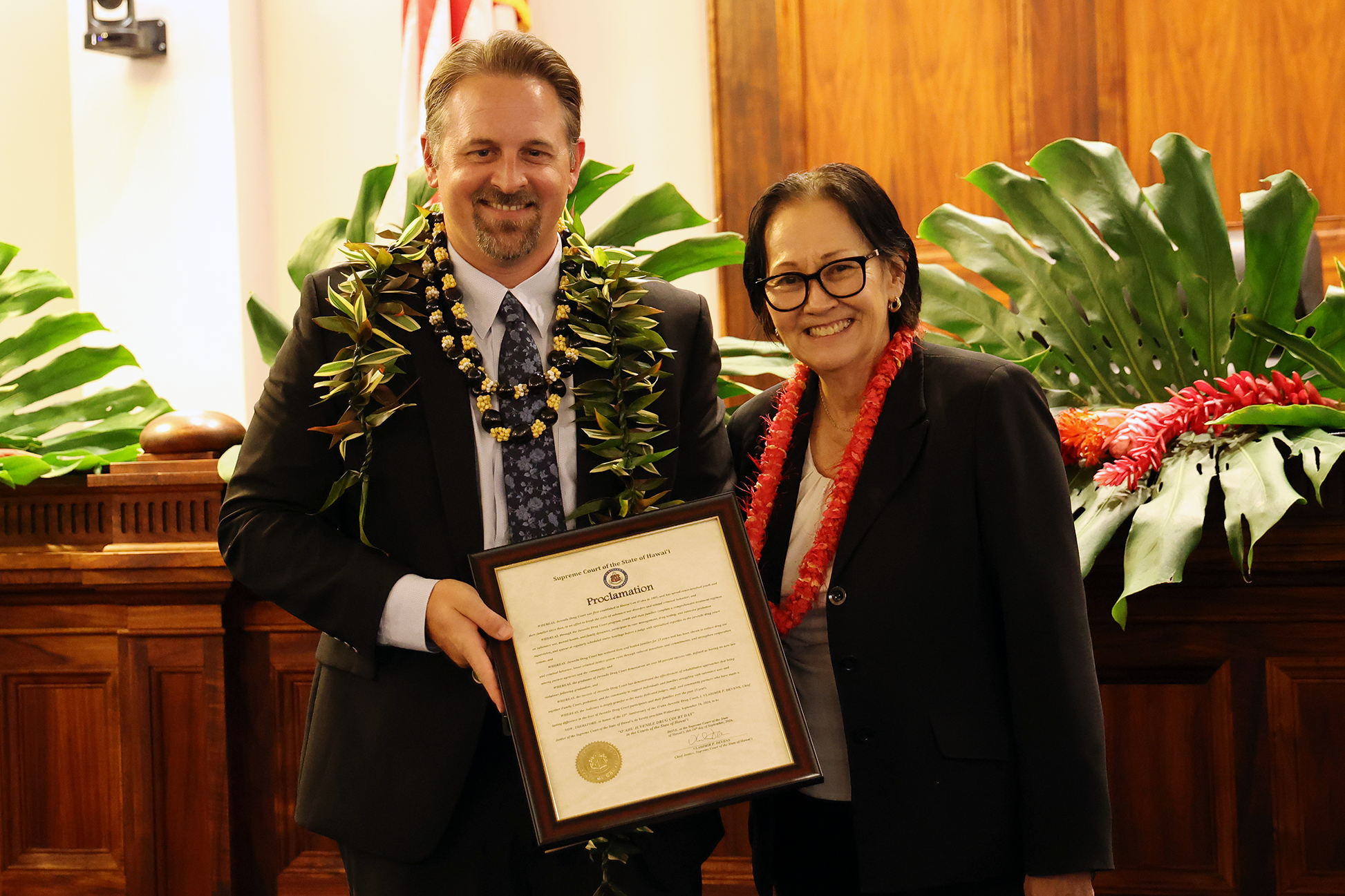
Associate Justice Sabrina S. McKenna (right) presents Juvenile Drug Court Judge Robert J. Brown with a proclamation declaring Sept. 16 as Oʻahu Juvenile Drug Court Day.
Celebrating 25 Years
Associate Justice Sabrina S. McKenna presented a proclamation issued by Chief Justice Vladimir P. Devens declaring September 16, 2026, “Oʻahu Juvenile Drug Court Day” in the Courts of the State of Hawaiʻi.
The proclamation recognizes JDC for having “restored lives and healed families for 25 years” and expresses the Judiciary’s gratitude to the judges, staff, and community partners who have contributed to the program and the lives of its participants and their families.
First Lady of Hawaiʻi Jaime Kanani Green attended the celebration representing Gov. Josh Green and spoke about the heart demonstrated by the people who make JDC possible.
Brown reserved some of his most personal comments for the JDC participants themselves.
“You guys are what brings me joy in this program,” he told them. “You guys fulfill me. You guys are the reason I believe that what we are doing is right.”
Browning also recalled the difficult moments he experienced while presiding over JDC, but said those memories are outweighed by what happened when youth began to see possibilities for themselves.
“What I remember the most is the joy that I felt when I saw a young person in front of me who suddenly had that look in their face that they believed,” Browning said. “I remember the happiness that that brought. I remember the hope that I felt.”
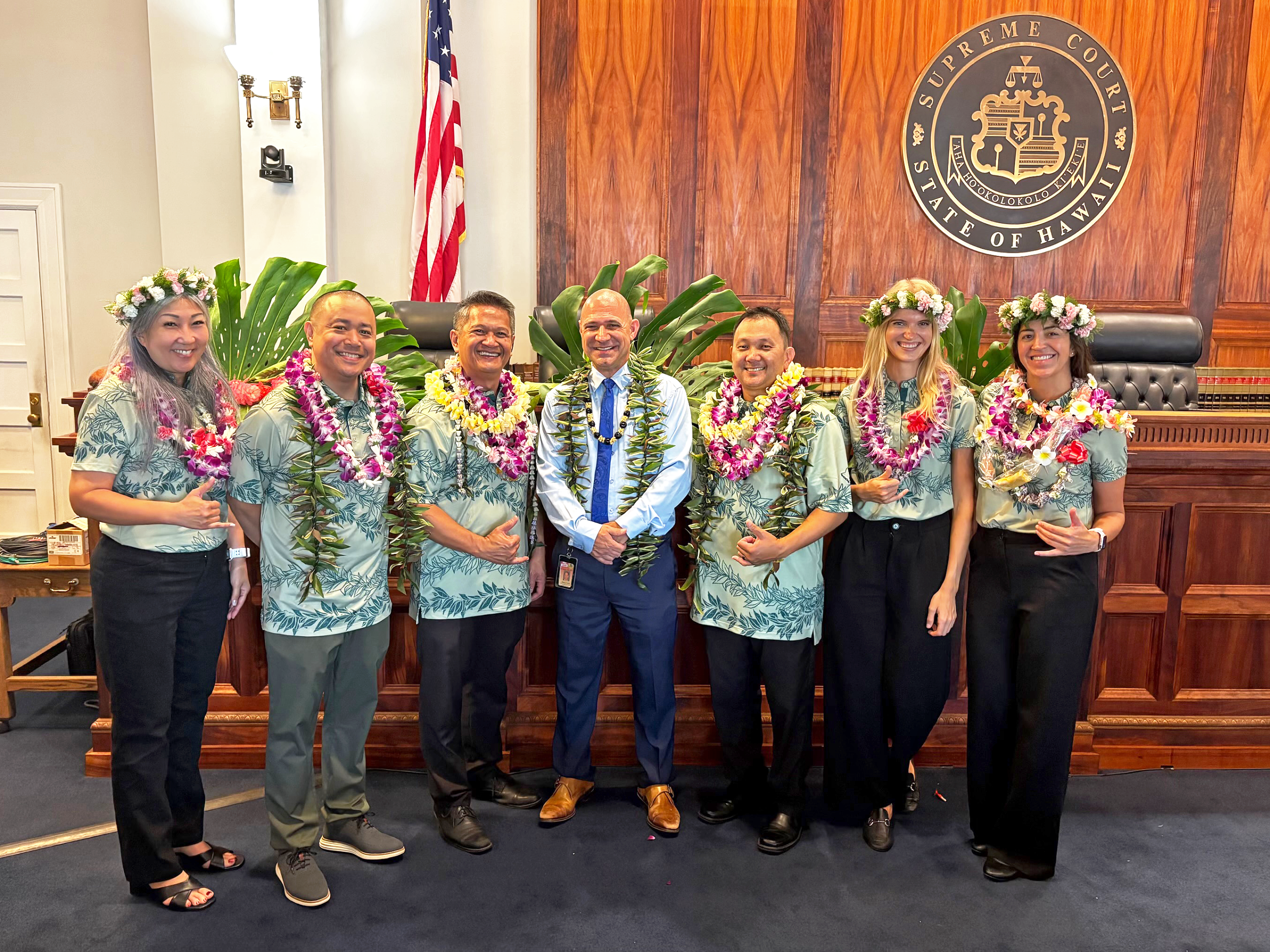
From left: Juvenile Drug Court Probation Officers Lisa Ogata and Christopher Soria, Administrator Joel Tamaya, Judge Brian Costa, Supervisor Derek Sumida, Probation Officers Jana Leyh and Sabrina Rodriguez.
A New Name for the Future
As JDC begins its next chapter, the program is also receiving a new name: Ka Hoʻokele ʻŌpio.
Hoʻokele means to navigate or steer, and Ka Hoʻokele ʻŌpio reflects the program’s mission of guiding youth and helping them navigate a path forward. The new name emphasizes the support, direction, and encouragement the program provides as youth work to overcome challenges and build healthier futures.
For Browning, the 25th anniversary is as much about what lies ahead as what the program has already accomplished.
“Twenty-five years ago, JDC was an idea,” he said. “Today, it is a legacy. And a legacy isn’t just about what happened. A legacy is about what is going to happen and all the lives that will be changed in the future.”