Announcement for JEFS users: Multi factor authentication will be needed to access the Judiciary Electronic Filing and Service System beginning September 13. Click for more information about multi factor authentication for JEFS.
Hawaiʻi Celebrates 30 Years of Drug Court During Specialty Court Graduation Ceremony
Posted on May 20, 2026 in Featured News, News & Reports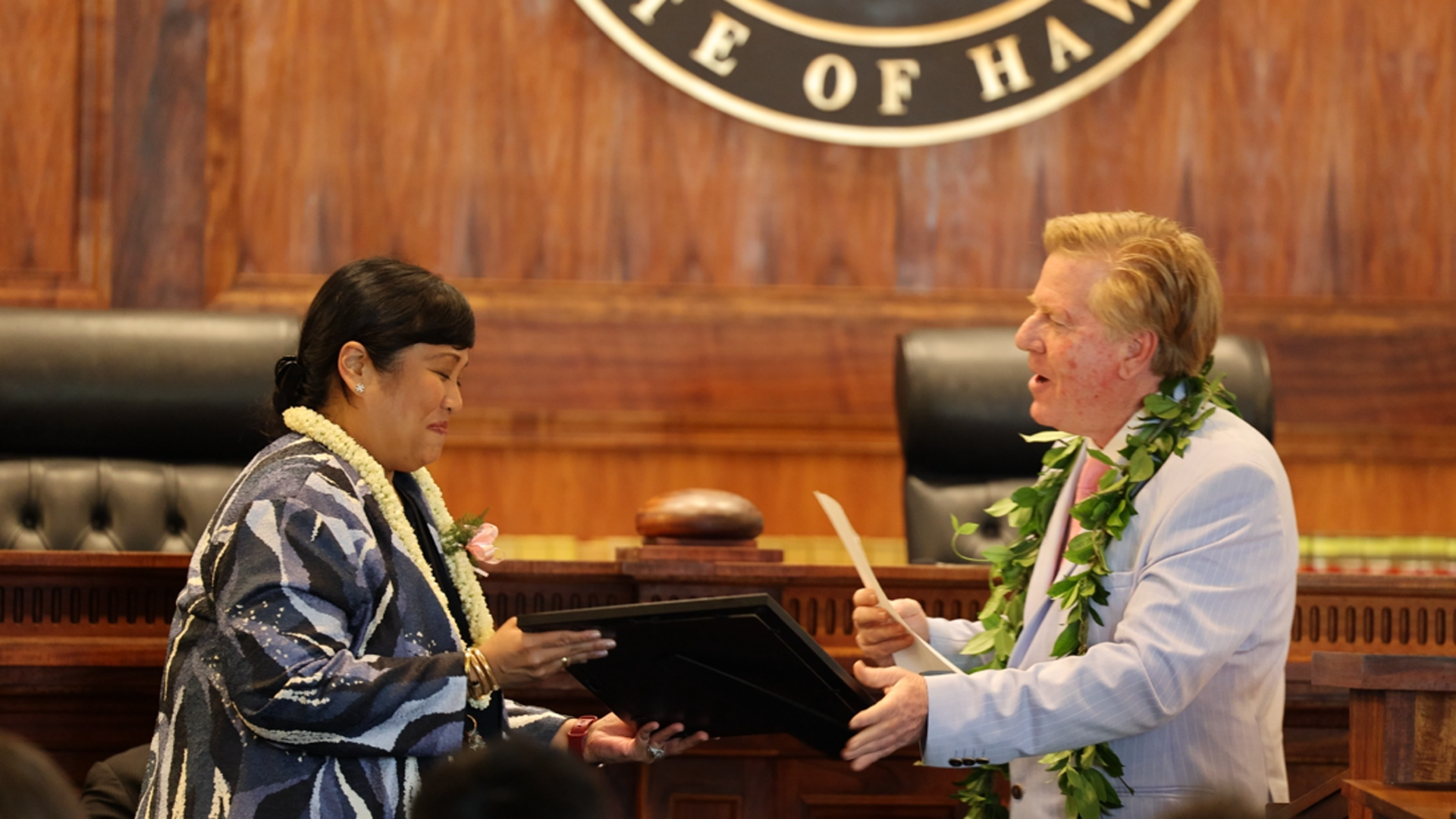
Associate Justice Todd Eddins presents Judge Clarissa Malinao with a proclamation from Chief Justice Vladimir Devens during a specialty court graduation on May 15, 2026.
When the first participant entered Oʻahu Drug Court in January 1996, Hawaiʻi launched a new approach to justice — one rooted not only in accountability, but also in the belief that treatment and recovery can help break the cycle of addiction and crime.
Thirty years later, that model has grown into a statewide network of Drug Court programs serving communities across all four of Hawaiʻi’s judicial circuits, helping thousands of individuals rebuild their lives while promoting public safety and reducing recidivism.
The three-decade milestone was celebrated May 15 during a specialty court graduation ceremony in the Supreme Court courtroom at Aliʻiōlani Hale. The event honored nine graduates from Oʻahu Drug Court, one graduate from Oʻahu Veterans Treatment Court, and three graduates from Oʻahu Mental Health Court. The ceremony represented the 94th graduating class of Oʻahu Drug Court, the 45th graduating class of Oʻahu Mental Health Court, and the 44th graduating class of Oʻahu Veterans Treatment Court.
Associate Justice Todd Eddins read a proclamation issued by Chief Justice Vladimir Devens declaring May 15, 2026, as “Oʻahu Drug Court Day” in the Courts of the State of Hawaiʻi. The proclamation recognized Oʻahu Drug Court as Hawaiʻi’s first treatment court and credited it with helping expand specialty courts statewide.
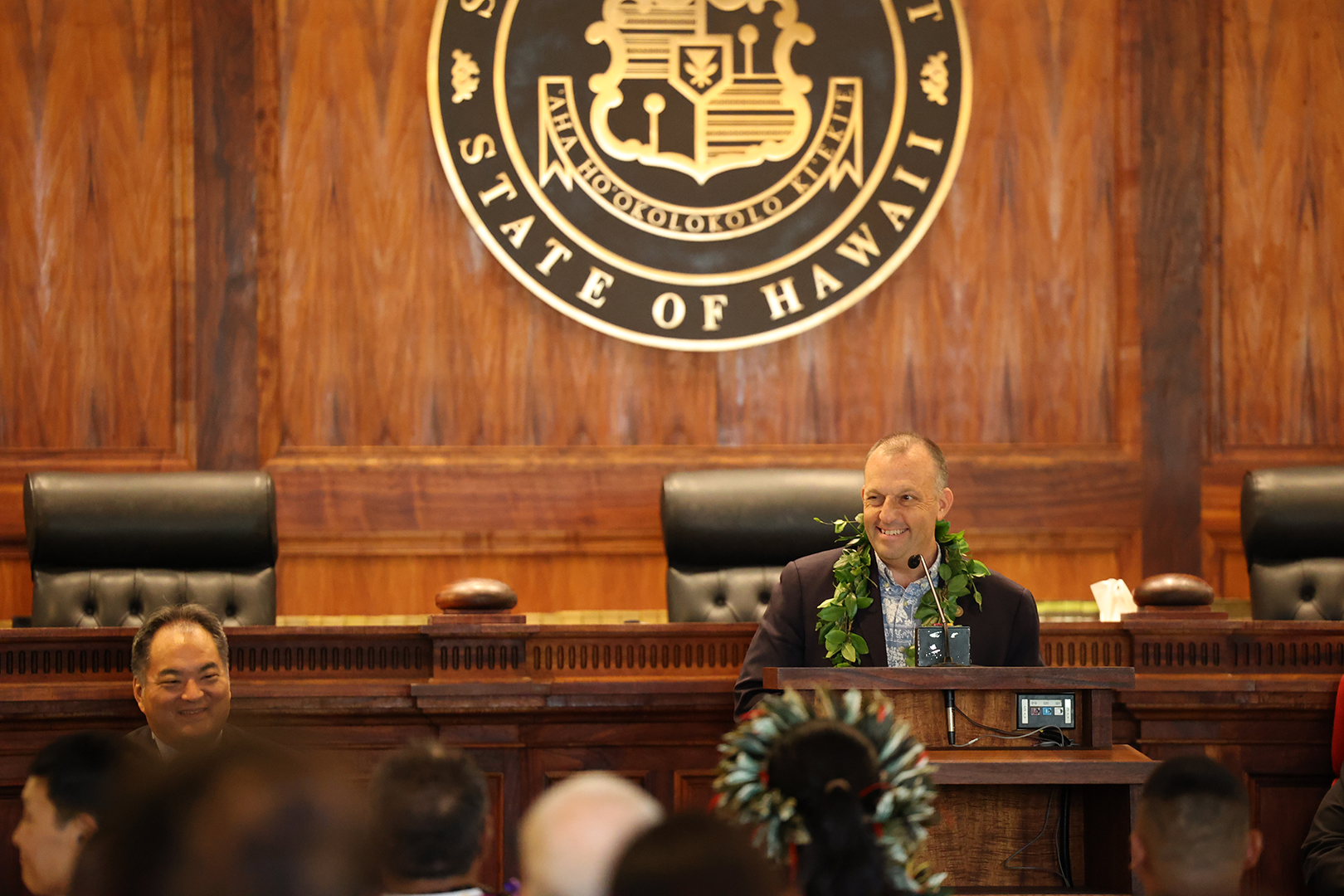
Hawaiʻi Governor Josh Green addresses specialty court graduates during a celebration held in the Hawaiʻi Supreme Court courtroom on May 15, 2026.
Hawaiʻi Governor Josh Green attended the ceremony alongside an overflow crowd of family members, friends, treatment providers, community partners, and supporters gathered to celebrate the graduates and the anniversary milestone.
Drug Court in Hawaiʻi began with a question posed in 1994 by then-Chief Justice Ronald T.Y. Moon: could a court-based treatment model better serve individuals whose substance use had contributed to their involvement with the justice system? An interagency committee brought together representatives from the courts, prosecution, defense, probation, public safety, health, and treatment communities to explore that question.
What emerged was a collaborative, treatment-focused program designed to offer an alternative to incarceration for eligible individuals with substance use disorders. With support from state lawmakers and federal grant funding, the First Circuit launched Hawaiʻi’s first Drug Court under the leadership of the late Chief Justice Moon and then-Judge James “Duke” Aiona Jr., who served as the program’s first presiding judge.
Over time, the model spread beyond Oʻahu. Drug Court programs were established on Maui, Molokaʻi, Hawaiʻi Island, and Kauaʻi, bringing the same core mission to communities across the state: helping participants address addiction, stabilize their lives, and move toward long-term recovery.
Today, Hawaiʻi’s Drug Courts continue to serve offenders whose criminal behavior is closely tied to substance use disorders. Participants are supervised through an intensive, court-based outpatient model that combines treatment, structure, and accountability.
Depending on individual needs, services may include substance use counseling, mental health and medical care, frequent and random drug testing, probation supervision, case management, employment and housing assistance, home visits, curfew monitoring, and regular court appearances before a Drug Court judge.
The goal is not simply to punish past behavior, but to help participants build a different future.
Drug Court in Hawaiʻi has remained grounded in nationally recognized standards, building on the original framework developed for treatment courts and continuing to align with evidence-based best practices.
In Hawaiʻi, Drug Courts have also evolved in ways that reflect the communities they serve. Programs increasingly incorporate culturally grounded practices and partnerships that recognize the importance of connection, identity, and place in supporting long-term recovery. By coordinating with treatment providers, cultural practitioners, and community partners, Hawaiʻi’s Drug Courts work to deliver services that are both effective and responsive to local needs.
The Drug Court model laid the foundation for the development of other treatment-focused courts across the state, including juvenile drug courts, veterans treatment courts, mental health courts, and women’s courts. While these programs serve different populations, they are rooted in the same core principles of accountability, treatment, and collaborative support.
For graduates, the impact of the program is deeply personal.
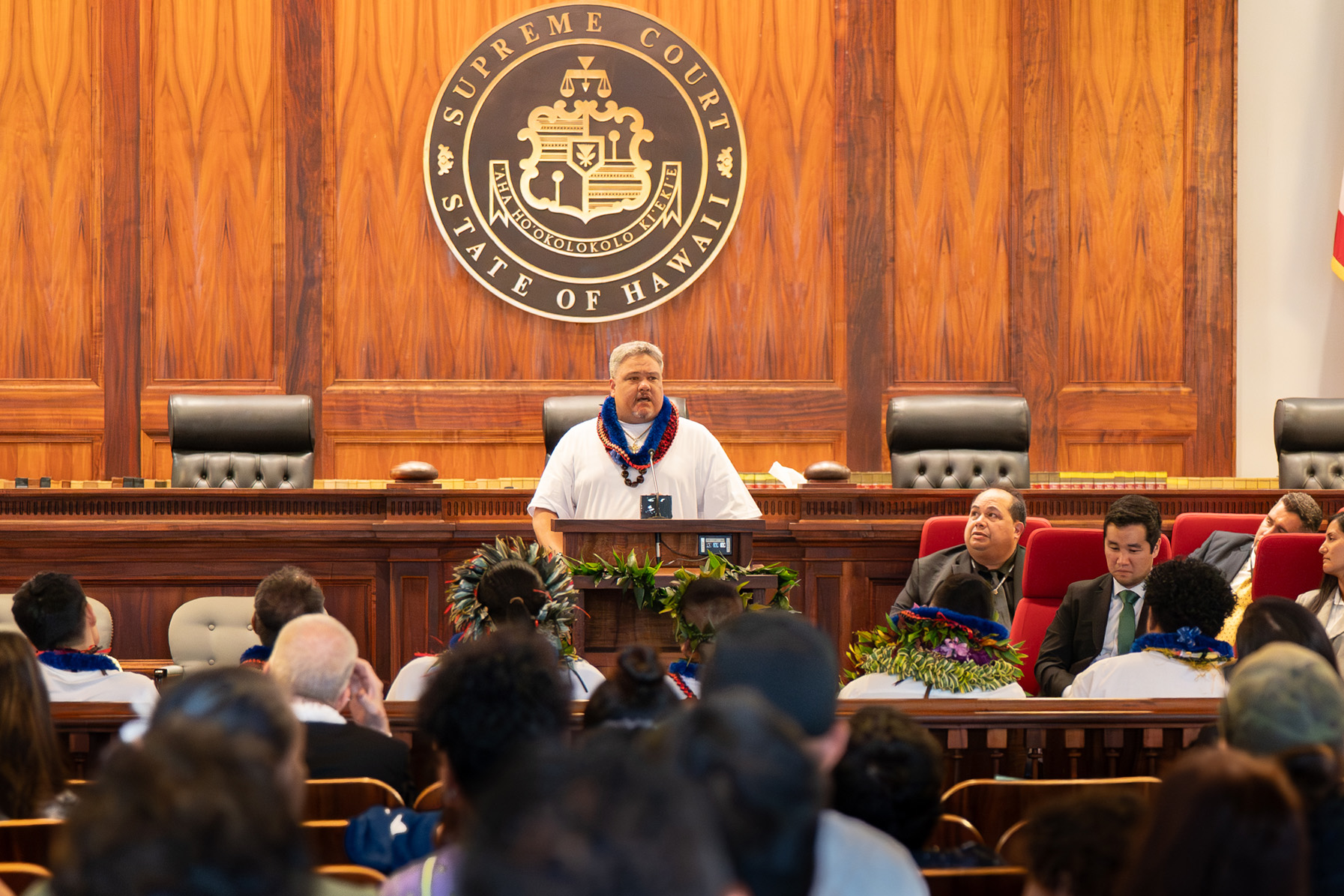
Graduate Clifford Cantrell speaks at Drug Court graduation on May 15, 2026.
“Today I stand before you a changed man,” said 2026 Oʻahu Drug Court graduate Clifford Cantrell. Since entering the program in April 2024, Cantrell has become a leader in Drug Court group sessions and now works as a chef at a local restaurant. “I owe everything to the Drug Court project. It saved my life,” he said.
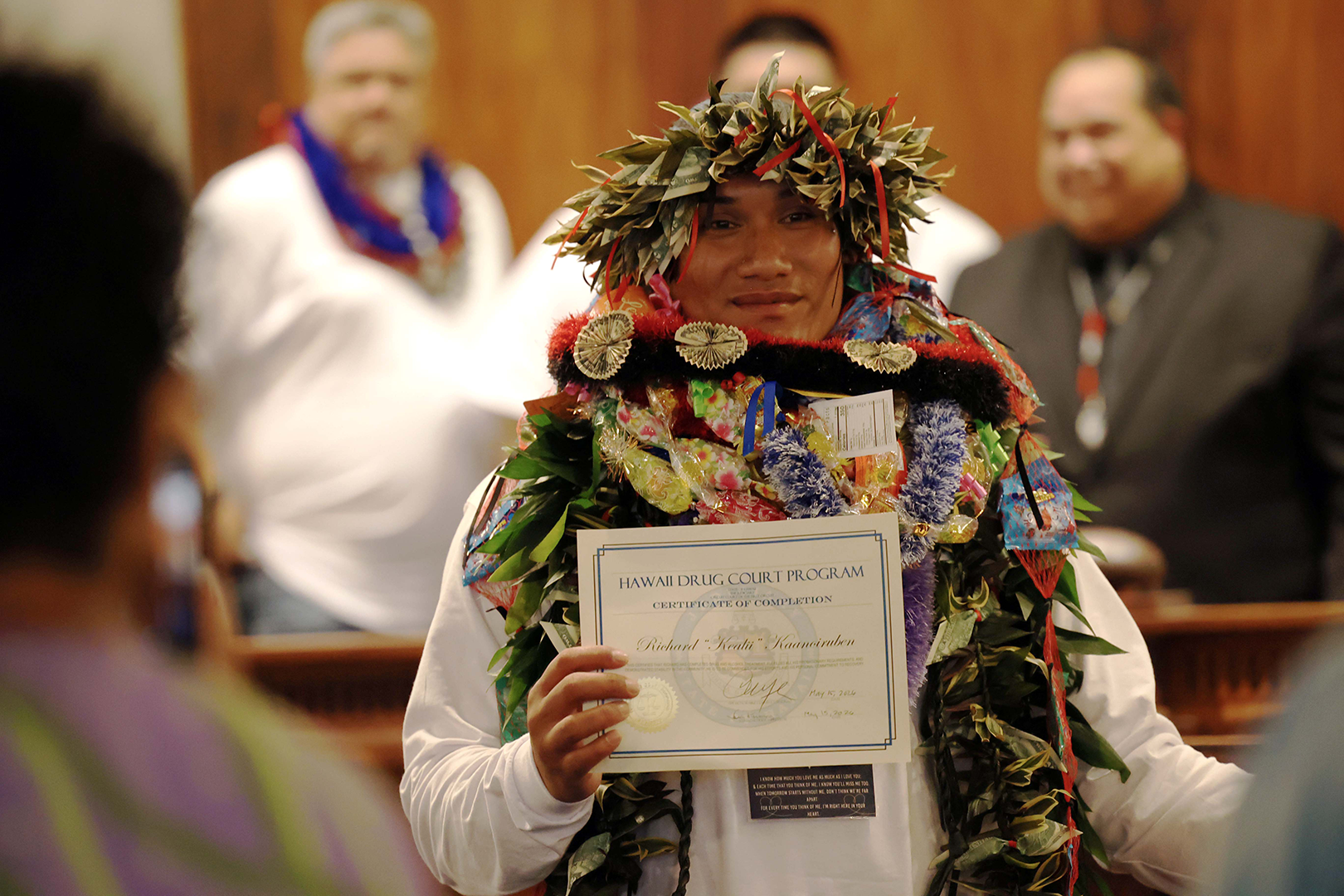
Keli’i Kaanoi-Ruben poses with his Drug Court certificate in the Supreme Court courtroom at Aliʻiōlani Hale on May 15, 2026.
Graduate Keliʻi Kaanoi-Ruben reflected on how the program changed his perception of the justice system.
“I always saw it as a place where people get locked up and put away,” he said. “But being here showed me something different. It is also a place where people are given a second chance. And I am standing here today because I was given that second chance.”
Another graduate, who previously shared reflections about the program’s impact, said Drug Court offered far more than a path away from substance use.
“Drug Court showed me that it’s not all about recovery from drugs to truly get better and make the program work,” the graduate wrote. “It’s about recovery from the lifestyle I was stuck in and the toxic decision making that kept me there.”
That graduate said the program reinforced accountability while also helping create the possibility of a new life.
“The things that Drug Court really reinforced were the consequences to my actions and the ability to gain a new life,” the graduate wrote.
After completing the program, the individual re-enrolled at the University of Hawaiʻi–West Oʻahu, continued working toward educational goals, found employment, and began rebuilding family relationships.
“I am reminded every day how precious my continued recovery is,” the graduate wrote, “and I would never have had the chance to do that without the opportunities that I had through the Drug Court Program.”
During the May 2026 commencement ceremony, Specialty Court Judge Clarissa Malinao told graduates their success represented more than simply completing a program.
“Today we honor something far greater than the completion of a treatment court program,” Judge Malinao said. “We honor your courage. We honor your persistence. And we honor the choices you made, not once but every single day, to follow a different path than the one that brought you here.”
The May 15 ceremony also highlighted the continuing growth of Hawaiʻi’s broader specialty court system.
Established in 2005, Oʻahu Mental Health Court provides intensive supervision and treatment for individuals with severe and persistent mental illness. The program partners with treatment providers and the State Department of Health’s Adult Mental Health Division to connect participants with psychiatric care, rehabilitation services, and personalized support aimed at reducing recidivism and promoting long-term stability. To date, 108 individuals have graduated from Oʻahu Mental Health Court.
Founded in 2013, Oʻahu Veterans Treatment Court serves veterans whose legal challenges may be linked to substance use disorders, mental health conditions, or trauma related to military service. The program combines treatment, supervision, peer mentoring, and coordinated support through partnerships with the U.S. Department of Veterans Affairs and community organizations. To date, 89 individuals have graduated from Oʻahu Veterans Treatment Court.
Since the first court opened on Oʻahu in 1996, 2,714 individuals have graduated from Hawaiʻi Drug Court programs statewide. Those graduates include 1,182 from Oʻahu Drug Court, 773 from Maui Drug Court, 42 from Molokaʻi Drug Court, 430 from Big Island Drug Court, and 287 from Kauaʻi Drug Court.
While each circuit’s program has evolved in ways that reflect the needs of its community, all share the same core principles: treatment, accountability, collaboration, and the belief that recovery can help create safer and healthier communities. National research over the past three decades has consistently shown that treatment courts can reduce substance use, criminal behavior, and incarceration costs.
What began on Oʻahu in 1996 as a new approach to justice has grown into a lasting part of Hawaiʻi’s judicial system — one that continues to offer structure, accountability, and the possibility of recovery to those willing to do the work.